
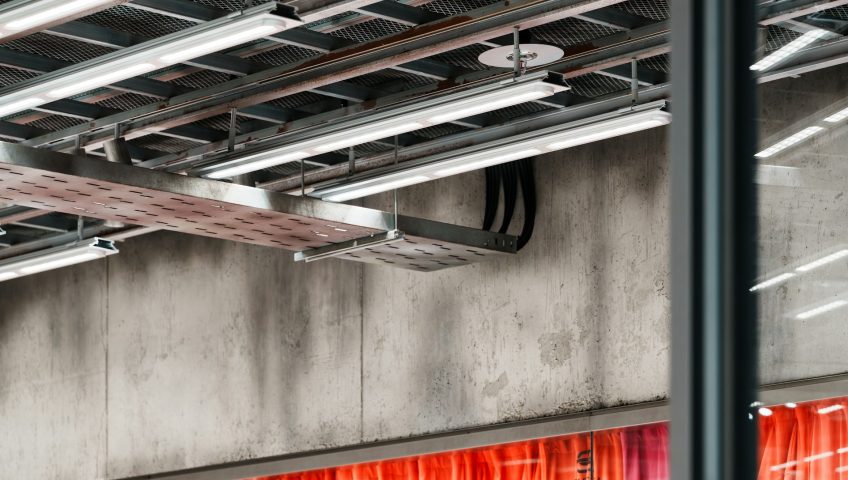
Stop the Disruption and Risk of Flickering Lights in Commercial Facilities
Flickering or unreliable lighting in a commercial space is a problem that goes beyond mere inconvenience. When the lights in an office space dim during a presentation, when retail displays pulse above a sales floor, or when warehouse high-bays flicker while heavy equipment operates, the atmosphere instantly becomes unprofessional, and potentially hazardous.
Beyond the basic aesthetics, these flickers often serve as the “check engine light” for your building’s electrical system.
A brief, intermittent blink might seem trivial, but it can signal significant problems lurking within your electrical system. Things like loose connections, circuits pushed to their limits, old panels, and subpar power quality frequently hide behind that seemingly innocuous flicker. Ignoring these warning signs could lead to damage to delicate equipment, unplanned outages, and a heightened risk of electrical fires.
A qualified commercial electrical contractor can track down the root cause and bring stability back to your grid. Below, we look at what these flickers actually mean, why DIY fixes are a liability, and how professional diagnostics protect your bottom line.
What Those Flickers Are Trying to Tell You
Not every blink signals an immediate disaster, but none of them should be ignored. Some causes are localized to a single fixture, while others suggest your entire distribution system is struggling.
Fixture-Level Issues
Sometimes the problem is contained to a small zone. This often happens due to:
- Loose lamps or poor installation in recessed or high-bay fixtures.
- Dimmers that are not compatible with specific LED drivers or ballasts.
- Cheap or failing LED drivers that have begun to strobe.
- Overloaded power strips in cubicles feeding too many devices at once.
While these issues are localized, they still kill the vibe of a showroom or conference room. Unstable lighting distracts employees and can even hurt your brand perception if customers feel the space is poorly maintained.
System-Wide Distribution Problems
More serious flickers point to the electrical “skeleton” of the building. These include:
- Deteriorated connections in junction boxes or lighting contactors.
- Worn-out switches or relays that serve entire lighting banks.
- Voltage fluctuations caused by large compressors or HVAC motors kicking on.
- Harmonics or phase imbalances that create “dirty” power.
As facilities add server racks, new AC units, or EV charging stations, the old infrastructure gets pushed past its limit. If you notice the flickering happens exactly when the elevator moves or the chillers start, your system is likely hitting its capacity ceiling.
Why You Should Never “DIY” Commercial Electrical Issues
Commercial electrical systems are dense, high-voltage environments. Even a minor flicker can lead back to a 480V panelboard or a complex control system. While it is tempting to have a handyman “tighten some screws,” the risks are massive.
What Your Facility Team CAN Safely Do:
- Note if the flicker is limited to one room or an entire floor.
- Track the timing. Does it happen at shift changes or during peak heat?
- Check if the flicker correlates with IT server reboots or equipment glitches.
- Verify that the lamps being used actually match the fixture requirements.
What Your Facility Team Should NEVER Do:
- Remove panel covers or attempt to tighten lugs on energized equipment.
- Try to reconfigure breakers or “swap” circuits to balance the load.
- Bypass lighting contractors or relays to force the lights to stay on.
- Install high-amperage breakers that do not match the original wire gauge.
These actions violate the National Electrical Code and create massive liability. If a fire occurs after an unlicensed fix, insurance companies often refuse to pay the claim.
Signs of a “Red Alert” System Failure
Sometimes a flicker is an early warning of an impending arc flash or total system meltdown. You need to call a commercial electrician immediately if you see any of the following:
1. Repeated Breaker Trips: If the same breaker trips more than once a month, there is a thermal or short-circuit issue that needs an eyes-on inspection.
2. Visible Arcing: If you see sparks at a switch or outlet when you plug something in, the device is failing.
3. The Smell of Ozone: A metallic or burning plastic smell near a panel is a sign that wires are melting.
4. Heat at the Panel: If a breaker or the panel door feels hot to the touch, you are in the danger zone for an electrical fire.
5. Widespread Dips: If the lights in Tenant A’s office dim when Tenant B starts their equipment, your main distribution bus or transformer is likely undersized.
Modern buildings were not designed for the current density of server rooms and high-tech machinery. Flicker is the visible symptom of a system that is running red-lined every day.
How Professional Diagnostics Solve the Problem
Solving a flicker in a commercial setting is a diagnostic project, not a simple parts replacement job. A licensed electrician takes a structured approach to find the “Why” behind the “What.”
The Diagnostic Process
A typical service visit involves more than just a ladder and a screwdriver. It usually includes:
- Thermal Imaging: Using infrared cameras to find hot spots in panels that are invisible to the naked eye.
- Voltage Monitoring: Hooking up meters to track sags and spikes over a 24-hour period to see how the building reacts to load changes.
- Phase Balancing: Checking if one phase of your power is doing 80% of the work while the others sit idle, which causes heat and instability.
- Power Quality Analysis: Looking for noise on the line from variable frequency drives (VFDs) that might be messing with your LED drivers.
The Fix
Once the data is in, the solution might involve repairing a loose neutral wire, upgrading a transformer, or simply replacing outdated lighting controls with modern, matched components. For buildings with integrated automation, security, and fire systems, stable power is the only way to prevent false alarms and data loss.
Secure Your Facility with a Real Assessment
Treating a flicker as a cosmetic issue is a mistake that often leads to a much more expensive emergency call down the road. Early intervention is always cheaper than responding to a total outage or a fried server room.
ROS Electric focuses on the high-stakes world of commercial power, data, and building automation. Whether you have recently expanded your IT footprint or just added new mechanical equipment, your electrical foundation needs to be verified.
A methodical assessment ensures that your lights, security cameras, and EV chargers all have the stable power they need to function. By partnering with a qualified commercial electrician, you shift from reactive repairs to proactive management.
Get Started with a Commercial Electrical Assessment
If you are ready to improve safety, reliability, and capacity for future demand, ROS Electric can help with code-compliant commercial electrical work. We focus on troubleshooting, system diagnostics, power quality analysis, and electrical upgrades and retrofits. Share your facility and operational goals to receive clear recommendations and a structured plan. To schedule an inspection, request a system assessment, or get an estimate, contact us.
Write a Comment